Another programming related post... I promise I'll publish something nicer next time.
Also, because Google insist on making their products consistently worse, I am unable to upload pictures. This is going to be even drier than usual.
Recently, Unity added a new tool to its arsenal, in the form of Property Drawers. They allow specifying how to display your own types inside Unity's editor interface, when contained as a variable of a MonoBehaviour. Previously we were limited to specifying how to draw a whole component, which had its limitations in terms of reuse.
So, now that you know they exist, you might start looking around for examples... only to find the most trivial one repeated over and over again: a Property Drawer for a class with one simple variable. But you want to display an array, or an array of colours, or a visual angle selector (which is used in an example, but its code is curiously missing). Something actually useful when editing complex games in Unity.
So, I'll save you an hour of reading through documentation and debugging weird errors. Property Drawers are very easy to use when you know what to pay attention to.
Basic case: a class with a Sprite picker
Let's create a simple class LayeredElement.cs, to organize Sprites.
LayeredElement.cs:
[Serializable]
public class LayeredElement {
/// <summary>
/// Order in which this element is painted,
/// 0 being the background.
/// </summary>
public int layer;
public int Layer { get { return this.layer; } }
}
[Serializable]
public class NonConfigurablePart : LayeredElement {
public Sprite sprite;
public Sprite Sprite { get { return sprite; } }
}
To display NonConfigurablePart we need to expose the layer and sprite variables. Currently I don't know how to display a texture/sprite selector using EditorGUI, so I'll use a simple selector and display the sprite independently.
NonConfigurablePartDrawer.cs:
using UnityEditor;
using UnityEngine;
[CustomPropertyDrawer( typeof( NonConfigurablePart ) )]
public class NonConfigurablePartDrawer : PropertyDrawer {
// Default Unity line height
private int textHeight = 16;
// All sprites wiil take the same area.
private int spriteDim = 60;
public override void OnGUI(Rect position, SerializedProperty property, GUIContent label) {
EditorGUI.BeginProperty( position, label, property );
// Store the original indentation.
// Since we are being drawn inside a component,
// changing it could modify how later elements are displayed.
int origIndent = EditorGUI.indentLevel;
// Obtain the properties we are interested in. Accessing variables by name is error prone, so be careful.
SerializedProperty layerProp = property.FindPropertyRelative( "layer" );
SerializedProperty spriteProp = property.FindPropertyRelative( "sprite" );
// Name of the variable this NonConfigurablePart has in the current MonoBehaviour.
EditorGUI.LabelField( new Rect( position.xMin, position.yMin, position.width, textHeight ), label );
// We don't use indentation, actually, so just get rid of it
EditorGUI.indentLevel = 0;
// Calculate the area to use for the layer field.
// 130 is the number of pixels Unity usually leaves before showing variable setters.
// Found via trial and error =)
Rect layerRect = new Rect( 130, position.yMin, position.width - 130, textHeight );
// Check if it was modified this frame, to avoid overwriting the property constantly
EditorGUI.BeginChangeCheck();
int layer = EditorGUI.IntField( layerRect, "Layer", layerProp.intValue );
if (layer < 0) layer = 0;
if (EditorGUI.EndChangeCheck()) {
layerProp.intValue = layer;
}
// Calculate where to draw the selector (right below the layer field).
Rect selectorRect = new Rect( layerRect.xMin, layerRect.yMax, position.width - 130, textHeight );
// PropertyField updates the property automatically, so no need to BeginChangeCheck
EditorGUI.PropertyField( selectorRect, spriteProp, new GUIContent( "" ), false );
// Calculate where to draw the sprite
Rect spriteRect = new Rect( 130, selectorRect.yMax + 5, spriteDim, spriteDim );
this.DrawSprite( (Sprite)spriteProp.objectReferenceValue, spriteRect );
// That's it. Some little house cleaning and leave.
EditorGUI.indentLevel = origIndent;
EditorGUI.EndProperty();
}
// Calculate height required by the component.
// Notice the absence of position; we cannot rely on a controlled width...
public override float GetPropertyHeight(SerializedProperty property, GUIContent label) {
// Layer (and label), selector and the sprite itself.
return this.textHeight * 2 + this.spriteDim + 5;
}
private void DrawSprite(Sprite sprite, Rect spriteRect) {
if (sprite != null) {
EditorGUI.DrawTextureTransparent( spriteRect, sprite.texture, ScaleMode.ScaleToFit );
} else {
// Draw a visibly unconfigured rectangle
EditorGUI.DrawRect( spriteRect, Color.magenta );
}
}
}
There is nothing extraordinarily complex here, but some very specific calls and behaviours.
Keep reading for something a little bit more complex.

2013-09-26
Implementing a Transition-based State Machine
Warning: this is one of the code heavy posts I once warned about. Those allergic to discussions of programming topics or big listings of code (C# code; it's not that bad), keep walking. Or stay and become harder, better, faster, stronger...
In this article I will introduce a (probably not so) new approach to implementing State Machines, mostly for videogames. The reference is, as usual, Buckland's implementation in his Programming Game AI by Example book. His version of the state machine was and still is the de facto standard when coding small AIs or logical behaviours. Although new and improved systems exist, like Behaviour Trees, FSMs are still pervasive in the video game industry.
FSMs have been slightly improved through time, as languages and techniques developed, offering new possibilities, but the core remains pretty much unchanged. Here I will introduce one major revision to how SMs are implemented and, more important, used.
Basic introduction to the classic State Machine
In Buckland's book, State Machines are composed of several elements:- The State Machine itself, which contains
- A reference to the machine's owner
- The current state to execute
- The global state to execute
- The previous state, in case a behaviour requires going back to it
- A base generic abstract class State<T>, with methods Enter, Update and Exit. Enter is called when the state becomes the current one, Exit when it stops being so. Update is called on every execution cycle (of the state machine, not necessarily of the game or entity).
- A collection of singletons derived from State<T>, one for each behaviour T can display.
- A messaging system which allows communication between entities. State<T> includes an abstract method to evaluate messages and treat them if appropriate.
- States are, curiously, stateless. That's why a reference to the owner is required: it must contain all the state information the machine needs.
- It is considered in bad taste (but unfortunately common) to transition from outside the states themselves, but the state machine usually allows this through several hijacking methods.
2012-10-10
Game Design Challenge: Wii U
This is probably the fastest GDC submission I've sent. From inception to emailing in barely 90 minutes. And, surprisingly, I'm quite proud of it. Still, I can't avoid thinking I've seen a very similar idea somewhere. EVE: Dust 514? Somehow, but not quite. Nintendoland? I didn't know much about it until 20 minutes ago. Sanctum? Iron Brigade/Trenched? These focus more on the tower defence side of things.
Anyway, meet Squad Action
Update: SA:WT is one of this month's highlighted entries! I'm glad that someone has enjoyed my idea. One more for the list of pending projects!
Anyway, meet Squad Action
Squad Action: Working Title
SA:WT is a hybrid DOTA/RTS multiplayer game for Wii U which takes advantadge of the console's online platform and varied controller possibilities.
Teams of 2 or 3 players work together to destroy the enemy base while keeping theirs safe. Each team will count with one commander and one or two ground troops.
The commander surveys the battle ground using the Wii U Gamepad and its touch enabled screen in RTS fashion.
The soldiers play in the main TV screen, FPS style, using a WiiMote and Nunchuck. They will traverse the combat area fighting the rival players and structures.
In local games the TV screen can be split up to four times to accomodate 2 full teams (plus two Gamepads), while online teams can play from different locations and screens.
Resources are collected by soldiers while alive, at a rate of one unit per second (main advantadge of killing enemies), defeating enemy troops or buildings and disabling the enemy commander's droid. Most of the resources collected are sent to the team account and a small part is kept for personal use.
Ground troops can return to the base to buy basic equipment and heal, but they cannot upgrade their loadout. The commander can offer equipement recommendations and loan part of the team resources to a player, so she can acquire equipment out of her reach. These loans would be later discounted from the players' collected resources, trading a short term advantadge for future income problems.
Options available to the commander:
- Build gates, sensors or turrets in their half of the map.
- Upgrade soldiers' armour and weapons.
- Buy and drop temporal buffs almost anywhere on the map, which can be picked by allies or enemies.
- Place warnings or attack signals on the map. In local games these can be seen by the enemy!
- Browse available equipment and mark recommendations.
- Loan resources to team members.
- Deploy a remote controlled droid.
Remote droids are controlled from a FPS perspective in the Gamepad display. They have limited combat capabilities but are the only way to build the most powerful structures, repair damaged equipment or resurrect team members before their respawn time arrives. However, while the bot is deployed the commander can do nothing else and, should the bot be destroyed, they'd be unable to play for 15 seconds, or up to a minute late into a match. The bots can self-destruct without penalty, but it takes 10 seconds until the sequence completes, during which the robot cannot move and is open to enemy attacks.
The bot can also transform into a stationary turret atop the team's base core. These turrets are very powerful and provide extra protections to nearby allies, but turn slowly and if destroyed will damage the base noticeably.
The winning team will be the first to destroy the enemy base or reach a set amount of resources, depending on game/map type.
Update: SA:WT is one of this month's highlighted entries! I'm glad that someone has enjoyed my idea. One more for the list of pending projects!
2012-03-16
Review: Rez (Q Entertainment/Sega/HexaDrive, 2001/2008)

Platforms: Dreamcast, PS2, XBLA
In one of my first posts I exposed my distaste for the punctuation system used in videogames. As I said, my opposition stems mainly from videogame reviewer's reluctance to give marks below 6 and the 1 through 10 standard reliance on a mythical perfect game. This perfect game is, per se, impossible, and using it as a measure, therefore, pointless.
Although I remain adamant that perfection is unattainable, I request permission to exercise my right, as human being, to contradict myself by stating that Rez is, without the slightest doubt, a perfect game. Its perfection, however, does not arise from the impossibility of improving it -I'd gladly accept one or two extra areas on par with the ones available- but from the fact that any enhancement it received would fail to add anything to the experience as a whole. Rez can only improve by becoming larger, prettier or more literate, but none of these changes would make it any better than it already is. This is clearly demonstrated by playing the HD version available for the Xbox360. It looks better, sounds great, is panoramic and has a couple extra features, and remains exactly as good as the PS2 or Dreamcast versions ever were. I still play the PS2 and HD versions from time to time, depending on which one is at reach, and can't fault any of them.
 |
| Rez, gloriously low res |
Players first learn to shoot. And shooting feels good because it produces a nice, simple note. Shooting up to eight targets at once feels even better, as it creates a simple and beautiful tune: duru-ruprup, turaruraru. As enemies get bigger or closer together, the rhythm and tone get more frantic, luring the player into the musical frenzy.
Collecting items is revealed to be important because they are obviously different and shooting at them just sounds better. As if that wasn't enough, accruing eigth blue items (less in later phases) transforms the avatar into progressively more detailed depictions of completeness and tranquillity AND awards you extra lifes. There is no indication of how many impacts you can sustain, but it can be instinctively guessed. Collecting red orbs turns out to be useful too, as each one, up to four, becomes a short-lived, powerful auto-shoot at your request.
 |
| It's mine, my precioussss |
That's it. With just one verb (or one stick and two buttons), sound cues and simple graphics Rez is able to completely explain itself in the first five minutes of gameplay. As levels progress, the wording gets more frantic, but the meaning remains the same: the enemies are instruments and you have to compose art. The music and graphics, although fundamental to the game, never take the focus away from the core, and only work to enhance it.
Music is simple and integrates with the frequency and spacing between enemies. Your shots are synchronised to the music, and so is the whole of the screen.
The background and reticule are rendered in wireframe -and a subtle glow when aiming, so that enemies and other targetable objects can be easily identified. Enemies feature simple shapes, almost iconic, with the most distinctive being tentacled beings composed of hundreds of small squares. Whether this minimalistic approach was a matter of hardware limitations or a choice made long before development started I can't tell, by I can assure you that contention in the graphical area was the best thing they could have done.
 |
| Simply beautifil of beautifuly simple? |
Beyond shooting, Rez offers variety in the form of mutating levels, mixing different possible configurations each time a level is played. After dozens of hours spent in its world I am still surprised by combinations I had never seen before.
 |
| The man changes its behaviour depending on your proficiency |
Conclusion
I can't create the chart right now, but as soon as I can, I'll upload it. Spoiler: Rez is at the top and Child of Eden is dangerously close the bottom.
EDIT:
 |
| Here's the chart. |
* Marvel has sadly reduced the word "astounding" to meaninglessness.
2012-01-04
Review: Etrian Odyssey III: The Drowned City (ATLUS, 2010)

It took long, but two days ago I finally beat The Drowned City's three endings, so at last I can say that this is, accompanied by Castlevania: Order of Ecclesia, at the top of my DS charts by a decent margin.
Etrian III is built like a good post-rock/post-metal/prog album or song, as any decent game should be. A common thematic undercurrent and instrumentation (story, mechanics, general rules) encapsulates the whole, slowly progressing so it never repeats itself, revisiting previous moments with a new twist, and always insinuating the breaking points when everything will come together gloriously. Also, there must be something unexpected inbetween, plus new things to discover when we decide to play the album again.
EO3 follows this rules almost to the letter, with its level design getting more complex as time goes by. All of the 5+1 strati our guild must conquer start conservatively, introducing minor changes to the basics and new monsters to get used to. Once the player got used to the new environment, new game elements are introduced in the following levels (new FOE patterns, currents, mission types or traps) to expand the world as we go down, one level after the other, always yearning for the next surprise.
EO3 also feels like the great comeback from that band that so deeply dissapointed you with their second album*. After identifying everything that failed in Heroes of Laggard, ATLUS removed almost everything new, refined the formula and added some amazing new tricks.
Once sea exploration, weapon forging and the new classes are introduced at the beginning, all goes back to old style Etrian, until the real additions are revealed half way through: a second city, subclassing and story branching come quickly one after another, setting EO3 as a whole sequel, instead of the expansion feeling that surrounded all of EO2. And, eventhough story branching seems irrelevant at first, it is later put to good use at the end of the 4th stratum, when the consequences of each choice are finally introduced. And with this the pieces are set for the final feature introduction: meaningful replaying in a proper New Game+ mode for the first time.
All this together manages to make this third entry in the series superior to the original, including its amazing revelation of the 5th stratum.
 |
| Princess, Ninja, Pirate. Add water. Mix. |
Another addition, although less notable, is the existence of invisible areas, where auto-mapping is disabled and in which FOEs don't show in the map. It is, however, quite a minor feature, requiring just a bit more caution and attention from the adventurers.
2011-12-14
Too many bundles
 |
| Cave Story seen by @naramura. Shared by @Nicalis. |
Add in Desura's Indie Royale bundles, with its 3 weeks cycle, UK's The Little Big Bunch, supposed to start today, and the fact that indie developers were already quite fond of selling their games in packs, and you have way too many offers like this in a considerably small territory.
Although I like the idea of selling games this way, which clearly works and benefits every participant, I'd like it to stop for a moment and take a breath. Think of the consequences this madness is bringing.
Right now, we live in an ecosystem in which players start wondering whether buying an indie game at release makes sense. If it is any good, chances are it will be sold with some other games at very low prices, even as low as 0.01€, in less than a year. Early buyers are heavily punished.
The standard price for games is also being established at a dangerously low margin of "as little as you want", potentially harming developers who prefer to set their one prices and use sales or gifts to attract new buyers as time goes by.
If anyone involved in this madness reads this, I urge you to reconsider. Keep the good work, release and promote bundles, but slow down. Don't burn the formula or your clients' pockets too fast, or the market will be saturated and possibly damaged. Now that the indie scene is starting to flourish, we must take special care that it grows strong and at a good pace. By watering it to much we risk rotting its branches and roots.
Disclaimer: I'll still acquire HIB 4, of course. It's the best bundle I've seen since Introversion's Anthology! And I love playing from Linux.
2011-12-12
Roguelike Line of Sight by Eric Lippert
 Isn't it wonderful when two passions get intertwined in ways you never expected? The passions in question are Roguelikes and the C# programming language, joined in the person of Eric Lippert.
In this week's post Eric has tackled the problem of developing a line of sight algorithm for roguelike games, which he'll apparently follow with an implementation. An interesting read for programmers and players alike, which saved me the time required to read through the forums myself =) And don't worry, the technical details are not enough to blow anyone's brains*.
For those not in the know, Roguelikes are top-down view computer role games of unusual graphical simplicity (environments, objects and characters are usually depicted using ASCII symbols) and extremely complex worlds. The genre's identifying marks are random generated dungeons, permanent character deaths (the save file is deleted if the character dies) and cumbersome controls. You should check ADOM (Ancient Domains Of Magic) or NetHack, if you haven't already.
And Eric Lippert is a respected member of the .NET community, having worked on the compilers of Visual Basic and C#, and lately leading the development of Roslyn, an on the fly VB.NET and C# compiler and analyzer.
* Disclaimer: No guarantees regarding the rest of the blog. Tread with caution.
2011-11-19
Fragmented lives
Two days ago I watched, once again, Trois Couleurs: Bleu, the first movie in Kieslowski's Colours Trilogy. In that movie music is used to illustrate the main character's missing links with its family. And all the while I wondered: why do games so rarely use music and game elements to such effect. I've seen this done, from time to time, although not to its full potential, and usually limited to the music. Character themes and such.
But how could this be turned into something exclusive to video-games? The usual is removing characters which enable secondary actions (Beyond Good & Evil's partners, Dark Souls's Fire Keeper), or an object (Sands of Time's dagger), but I can't think of an instance in which the player's actual ability to interact with the environment was limited or bolstered by changes in the protagonist's motivation or expectations. Except, once again, Demon's Souls and Dark Souls' human/ghost/undead forms come to mind.
I'll give some thought to ways this could be accomplished, or other games I've seen something like this.
And that's it for today.
2011-10-09
Running out of games to buy

Original post:
Today I have learnt that the next chapter in the STALKER (no more s.t.o.p.s., please) series will come with a little present: DRM requiring constant internet connection. Another thing I've learnt today is that I will not play that game. And that realization hurts, because I am a huge STALKER fan. I own the trilogy: Shadow of Chernobyl, Clear Sky and Call of Pripyat. The last two, I bought them on release date, and was proud of having supported GSC.
Why not buy STALKER 2? I will not accept been treated like a criminal by default, and I have already been bitten by this DRM stupidity. Clear Sky in Western Europe was distributed by Deep Silver, who slapped TAGES into it. TAGES, I found out, is incompatible with my DVD reader, and what did Deep Silver's support recommend? Get a new DVD. Haven't bought a Deep Silver product since, the same as I do with any company who betrays my trust.
But, sadly, during the last years my boycott list has grown non-stop. The videogame industry is becoming more and more unfriendly to its clients, constantly creating barriers between games and players: DRM, online passes, activations and even DRMed save games. The joy of playing is gone, replaced by the absurd requirement of registering, activating, checking the internet, writing codes and what not.
CEOs of the world: I am tired of all this. I don't see the point in giving money to your companies, when you only think of ways to make me pay full-price and give as little as you can in return. I refuse to ask for permission to play my games and I sure don't like having to rely on your servers, either.
After more than a decade of faithfully buying several games per month, I find my options limited, but not for lack of promising games, but for an excess of stupidity in the industry. I've gone from buying 3-4 games a month, even if I had no time to play them, to 1 or 2, with luck. And that average only holds because of independent developers and Good Old Games. For me videogame news are just a list of games I will not play, either because I am boycotting the company as a whole (Ubisoft), or because I find the security measures excesive (all the rest). And you read it right: not play. I won't even bother pirating the game, because I talk a lot about what I play to friends and acquaintances, and I will not give free advertisement to Ubisoft and company. You are not getting even an indirect sale from me.
Once DRM is removed, as happened with Mirror's Edge and Mass Effect, I'll gladly buy the game. But, most probably, by then I've already lost interest in the game and the publisher will have lost a sale.
Nowadays PC gaming is almost completely lost to me, and I fear that Valve's intentions to integrate Steamworks into PS3 releases will bring console games to the ground, too, as online passes are starting to do. If things keep going this way, I'll have to forget about playing, and bring books and movies back as my main hobbies.
And I won't feel sorry for any of the developers who forced me out of gaming.
2011-10-06
League of Legends Dominion: impressions
For those not in the know, Riot just released a new 5v5 game mode for League of Legends. It's selling point is that it is based on control points, rather than base defense and lane control, and offers a faster paced experience.
Short introduction
In Dominion each team base starts with 500 energy points and, each second, the team controlling more towers removes as many points from the rival's energy as the difference in controlled points. In order to make things interesting faster, Heroes start at level 3 and with enough currency for a couple of items, experience and gold are much easier to obtain and almost every fight is to death, especially the first encounters. This is because the time spent dead has been drastically reduced, to ensure players are more aggresive.
Is it any good?
It is fun, that's for sure. A match consists of 20 minutes of running around, attacking, defending bases, chasing and escaping, with the tide of battle changing easily. So easily that most games are won by very close margins. I have even lost a game to a team with only 1 point remaining.
But all this tension is continuous, without a pause or moment for reflection. While dead, you barely have time to look for your next item and buy it. There's no sense of progression, narrative or strategy, because all actions are more imrpovised than thought out. In this stressful environment communication is too difficult, to the extent that almost noone speaks more than monosillables. Also, the absence of secondary objectives, like guarding Baron Nashor's lair in the classic 5v5 map, takes away from the experience.
In the end, after a battle in Dominion, little more than the result is left. Each encounter in Summoner's Rift, on the other hand, feels like a story in which you evaluated your opponents and tried to counter their strengths, coordinating with your allies*. Also, since death is a lot more relevant, you learn to fear those characters which kill you in a breeze (Annie, Kata, hello!).
Like in narrative, the ideal is to introduce rest periods after moments of great tension, so the player can take a breath before going head first into the next fray. The tension must also go in crescendo, after each pause. This way, each new peak of excitement feels more pronounced**.
On the contrary, when exposed to constant action, as in Dominion, every new encounter is treated by the brain as the same thing, eventually losing part of its interest. If Dominion matches where any longer, it would soon become tiresome. Riot did well keeping things under 25 minutes, but even at that lenght I still get tired of this game mode.
Conclusion
Maybe Riot will some day manage to add extra depth to its new child, but until then it will probably remain a distraction from repetition. Its advantadge is that rival DotAs don't have a secondary game mode to break the monotony, once the competition from Valve and Blizzard arrives.
LoL's best card, its extremely wide and varied hero roster, might not be enough to fend of the attacks by itself.
However, I am not convinced that Dominion will save LoL from Valve and Blizzard's attempts at stealing its market share. The genre has a small fan base and big companies can do a lot of damage to Riot, through advertisement and simple brand awareness.
* Of course, there is always a black sheep who only complains about the noobity of the team. Welcome to the sad reality of online societies.
** Check Schell's The Art of Game Design for more about narrative in videogames. Or any good book about narrative, actually.
2011-09-03
Adding replay value
Today I'll explore the diverse mechanisms I've seen commercial games use to make them replayable or longer than it takes to end the main story itself. The main idea is that players are social animals, so they talk about what they play with friends, work colleagues or their families. The longer they play your game, the longer they'll talk about it and the more likely it is their acquantices, be them physical or virtual, will buy your game too. Of course, they'd better have good things to say about the time sink you've built: bad press does not beat no press at all in this kind of close relatipships.
Trick 1: Irrelevant secrets
Hide things not that relevant to the main story around, like ammo, modified weapons or photos of the development team. Players will spend a long time checking for secret walls or trying weird stuff. If their wild ideas succeed from time to time, they will keep at it. Otherwise, they'll stop trying and focus on the main game.
Pros: Easy to add.
Cons: They must be placed around evenly. Too many secrets or too few in one region of the world can create false expectations.
Examples: Any game with hidden power-ups or easter eggs.
Trick 2: Added background
Hide stuff which gives some insight into the world, the enemies or allies, which is not essential to ending the game. Jokes and logs fit well here.
Pros: Easy to add, since most of it should already be in the game reference documents. Role players love stuff like this.
Cons: Do not break the continuity. These extra dots in the drawing must be perfectly alligned with the ideas presented in the main game.
Examples: System Shock, FEAR, Baldur's Gate, Riven.
Trick 3: Super-objects
Hide game breaking equipment or abilities. Make most of them really hard to discover and even harder to obtain. If they are painfully boring to get, much better.
Pros: Bragging about the übersword feels so good.
Cons: Requires creating new items and/or puzzles. Most players are not willing to spend hours trying to achieve a secondary element.
Examples: Final Fantasy (VII, IV, V, VI, VIII, IX, X, XII...), Deus Ex.
Trick 4: Super-enemies
Add and extra challenge by including side missions with hellish fiends.
Pros: Once again, bragging rights. This comboes with Trick 3.
Cons: Make sure players understand they are not required to kill them and keep them away from the average player's path, or they will be very upset. Designing god-like monsters which can be killed requires a great understanding of your world's rules.
Examples: Final Fantasy, Castlevania.
Trick 5: Challenges
Add challenge rooms independent from the game whose only purpose is testing the player's ability. Time attacks or score rankings can hook players for a long time.
Pros: These are relatively easy to implement. Discarded levels, as well as parts of game sections can be reused.
Cons: It relies completely on your game being absolutely fun to play.
Examples: Batman: Arkham Asylum, Braid, Lara Croft and the Temple of Light.
Trick 6: Completion marks
Fill the world with riddles or puzzles which are there just to be solved. Nothing is earned from solving them, save reaching the desirable 100% completion.
Pros: They can be easily added to almost any kind of game.
Cons: If they don't integrate well with the world, the suspension of disbelief is at risk.
Examples: Batman: Arkcham Asylum, Castlevania (map completion).
Trick 7: On-line
Story be damned. Let's shoot at other players in the same maps until the end of times.
Pros: It works, often.
Cons: Competence is legion. Creating this along a single player experience is like building two different games with shared assets.
Examples: Call of Duty, Metal Gear Solid 4.
That's for no replayability at all. Now, how about starting the game again...
2011-07-10
Virtual economies
When facing a rough problem it is common to study similar environments, looking for potential solutions. Virtual worlds, being all the rage, should have been the first place academics turned to, looking for advice, but they didn't, so I have the honour to publish my findings first. What can we learn from videogame worlds that would help us get out of this supposed crisis? After carefull study I've found that, apart from "beating the bad guys with the biggest sword you can find", there's nothing for us in here.
Really, videogame worlds have it much worse than us. Capitalism's main flaw is in its reliance and dependence on inflation to prosper, but worlds like Hyrule, Hillys or Final Fantasy Land are burdened with the much, much worse phantom of hyperinflation, and each tries to decrease its effect the best they can.
Origins of the inflation
One common issue in RPG worlds is the recurrent monster invasion, which brings chaos and suffering. It happened in each of the Phantasy Star games, in Hyrule, the Mana world... everywhere. But its direct effects are not that bad. I can't remember many towns destroyed by the monsters in any of those games, but what I remember is that all monsters, from cacti to dragons, drop legal tender, be it Gil, Rupees or Meseta, in generous quantities.
The direct impact of this simple fact is staggering: in whole worlds, when travelling from empire to empire, or even between planets of the Algo System, you'll use the same currency everywhere. Monsters provide the common ground for a planetary economic system that the UN can only dream of, with almost free manufacturing costs and little rewards for forgers.
The catch is that there is always new currency being coined, at an uncontroleed rate. If you want to eat roast vegetables, you just need to go out, kill a Giant Onion or Carrot, pick the loot and use it to buy the roasted version of whatever you killed. And the same happens every morning, in every house, in every town. And the amount of coins in circulation increases constantly, maybe not too fast, but in a year you might find that it takes killing two Giant Onions to buy one roast onion. And in a hundred years, when the next monster invasion starts, the value of the currency will drop so fast that it won't be even funny.
So how do you control inflation in a chaotic system like this?
2011-06-21
Might & Magic: Clash of Heroes (HD) (Capybara, 2011)
Platform: PSN, XBLA, (DS)

The high definition craze is hitting with force this year and Ubisoft is making sure it is at the front line of this new fashion. In its zeal to outnumber anyone's HD rehashes it is now releasing re-skinned versions of one year old DS games. Well, at least they've had the decency to spearhead this new idea with a decent game, which did not get the attention it deserved. Unfortunately, the port didn't get the love it deserved, either, and it is just a port, with small fixes and brand new outstanding problems.
I will not go in depth into Clash of Heroes' mechanics and merits. To cut a long story short, it is an interesting and entertaining mix of your average tactics RPG with Magical Drop and Magic: the Gathering. Or something like that. It is quite unique. For more info, internet is full of reviewes of the DS original, and the modifications made to the new version do not invalidate them.
Regarding the common ground between both versions, I'll say that my favourite part remains intact: the puzzles, in which you are given one turn to prepare a number of attacks. They serve as tutorials for advanced configurations and how to best take advantadge of the rules. The bad is mostly the same, too: the last chapter is too simple and uninspired, consisting of, basically, going forward to advance, backwards to grind, fight the two final battles and that's it. Balance could also be improved, with random battles sometimes featuring too strong enemies for the current level of the player, or the level of bounties being inconsistent. Also unfixed is the possibility of losing bounty hunts without being warned, if the player decides to try a different one.
About the HD remake, I will say that the new art is, in most cases, great and very well designed. The only problem here is that some generic portraits are direct high resolution exports of the DS's vector graphics, looking like crude drafts in comparison with the rest. Also updated were several powers, units and objects, which were greatly needed. Things seem a bit more balanced now in multiplayer, which was absolutely vital for it to have a change to succeed. Also, the story mode difficulty has been reduced, but you'll still want to throw the controller a couple of times, specially during the last chapter.
 |
| Multiplayer is almost the only ocassion when the game's heroes actually clash |
2011-05-07
Review: Mass Effect 2 (BioWare, 2010)

Platform: PC, X360, PS3
Mass Effect, the first game in BioWare's intergalactic saga, turned out to be one of the best RPG blenders of the past decade. Despite some flaws, it might even be one of the best in video game history. It is up there with System Shock and Deus Ex, becoming part of a trinity of very different games with very similar concerns, each of them a testimony of how far available technology could go to create believable environments, characters and plot, and how to take advantadge of constraints.
System Shock, Deus Ex and Mass Effect have something else in common: their sequels departed considerably from the original. In System Shock and Deus Ex it was, mostly, a matter of technology and standard shifts. System Shock was released when the FPS genre was still crystalizing and its, admittedly overcomplicated, control and inventory schemes failed to become the rule. Deus Ex 2, on the other hand, changed the reference platform from PC to the booming console market. In both cases, the result was a considerably simplified version of the first game. However, Looking Glass used the opportunity to create a completely new kind of game, while Deus Ex: Invisible War remained a dumbed down version of its predecessor.
System Shock 2 is nowadays a classic, while Invisible War is just not.
Between Mass Effect and Mass Effect 2 no such technology or standard shift happened. All the modifications to the formula were the result of fans feedback, internal development and, I guess, some pressure from EA. And those changes left a mark even bigger and scarier than anything done in Deus Ex: Invisible War.
What happened?
Sequels of the world be aware of the tale of Mass Effect. Quite a start for a saga, raised from illusion, care and depth, by many loved, despite its flaws, into change it was compelled by EA's suits and internet boards.
Not too good a shooter nor much of an RPG, that was its cross, but the way of the bender was never meant to be easyly walked. Still it sold in the millions and, once DRM was gone, I bought it and rejoiced.
Things looked bright for BioWare and its new step-father, dollars in the pocket and still two sequels short, there was much to win, while little could be lost. Yet, greed took its toll, Mass Effect 2 was rushed to market, changed for the sake of change, dumbed down to please the masses of FPS, TPS players who about Mass Effect complained.
"The Mako is plainly a bore, with little to do in outer worlds, the arsenal too ample, the stats a ton, too much to watch and learn, overheating weapons are plain odd, and why is not Tali in my bed?"
"Just let us run and gun, the next gun better than the rest, picking weapons' not that great. I play to have some fun. Oh, and could you add some mini-games?"
Someone compiled all these requests, wrote them in a chart and forced them into the game. They might not fit well, or needed more thought to blend, but the release date must be met. "Just work less on the PC port. Like anyone will care."
And Mass Effect 2, my friends, is what we have left. By the way, this is the farthest I could take all this prosaic verse.
2011-03-29
Review: Shadow Complex (Chair Entertainmente w/ Epic Games, 2009)

Platform: XBLA
Shadow Complex is the first serious and successful attempt at recreating the feeling of oldschool 2D exploration shooters inside a 3D canvas. It's plain to see they focused on recovering everything good from Metroidvanias, while removing the design flaws and problems arisen by hardware limitations. A new aiming system, leveling bonuses or an attempt at story-telling are some of the additions they made to the Metroid formula.
A bit of history
Since the introduction of the third dimension in videogames many attempts have been made to recreate the classics in the new environments. Most of the time, however, the results have been underwhelming. The fast action available in simple 2D worlds proved constantly too much for the more complex settings required for believable 3D scenarios, unless action was limited to only two axes (Robotron X, Einhander).
Until Zelda 64's lock on was introduced, few had managed to get things slightly right. And even after that, failure has been pretty common. Proof of this is the respected Castlevania series, which, after four 3D iterations, found commercial success only when Mercury Steam decided to break with the old game style completely.
The Metroid series did better, with the Prime saga achieving almost unanimous praise, thanks to its merge of FPS mechanics with a lock on system, plus subtle story-telling. It did, however, rely on completely different gameplay and narrative styles than its precursors.
There is, as can be seen, a common thread going on, which is not even considering a return to the 2D. That approach has been left for handheld consoles, with the Metroid and Castlevania series for Nintendo systems, or remakes of old classics and shoot'm ups, like Ghosts'n Goblins for the PSP.
Of course, there have been constant homages, with 3D games re-creating 2D gameplay in small sections. The one I remember most vividly is Nier, which achieved levels of meta-gaming off the charts. Castlevania: Lament of Innocence and Metroid: Other M also played with pseudo 2D, although not too succesfully.
Chair Entertainment played it safe, making Shadow Complex a 2D game inside a 3D world. Movement is limited to the x/y plane, while enemies are free to move all around. As a result, Jason, the main character, is allowed to shoot in any direction too. The game automatically chooses how deep you are aiming, and it seldom does wrong.
Metroidvania at heart
Shadow Complex is probably the highest profile metroidvania ever done: edge technology, a big studio devoted completely to it, an expensive marketing campaign and the push from Microsoft. The studio dedicated apparently several months redrawing levels in paper form, calculating possible advance routes, secrets placement and planning all kinds of distractions to get the player off the track.
Also, the Metroid games were studied to he deepest detail, until their inner workings were grokked by the team at large.
2011-03-28
Review: Mass Effect (BioWare, 2007), Part 2

In my previous post I got into the shooter genes in Mass Effect, explaining what it did well, what did not and what compromises were made to please a bigger market. This time, I'll review the RPG in it, plus the setting and story.
Looking through the RPG lenses
Role-playing games are built on three main aspects: story, character stats and world interaction. The tighter they all feel, the better the final experience should be. Or, in other words, no matter how good your game is implemented and thought out, if those three pillars do not support steadily the game as a whole, the RPG player will notice.
BioWare were greatly experienced in managing all three elements, and it really shows in Mass Effect. The story starts well and ends better, with enough stops along the way; the world is complex and astonishingly detailed; the main character can be differentiated beyond genre, clothing and faces; and there are plenty of NPCs, secrets and things to pick up.
Let's talk about each of them with a little more detail.
Universe and story in Mass Effect
There are a lot of things to learn in this new Universe humanity has recently (35 years ago) discovered. Lots of worlds, life forms, political bodies, rebels... Almost anything. Many of them are presented as the plot or secondary quests advance and other times it is just in the form of codex entries. It is true that, pretty often, Shepard's ignorance of the most basic information of important issues is startling, making the exposition a little too evident.
But, most of the time, the player is simply provided some new info, readable on the menu, which add a lot of flesh to the limited bits of info the story forces on you. And, believe me, there is a lot of info in those codex. Every extraterrestrial race, coalition, political group or history event is explained in there. Quite a lot of the many hours I spent on my first play-through were spent reading every little bit.
And if that is detailed, wait for the moment you reach another planets. Each planet, no matter how irrelevant or small, has a description of formation, nature or civilization. And, what's even better, many of them are homages to sci-fi classics. Trantor and Dune are among the most recognizable, but there is space for many other plays on the genre. Quite a delightful time waster.
And the story does not lag around. I'll avoid the details, but the events progress smoothly, even when the player is allowed to play the middle section in whichever order she decides. There is a lot of conversation involved, but most are so well integrated with the events at hand that they come naturally.
The beginning is epic, and leaves many doubts about what is really happening, and as it all plays out, you start filling holes, discovering new, bigger ones and spending all the time intrigued about the possibilities. And when the final revelations come, they do with a vengeance. Lots of loose threads are tied, and even stuff you thought was only there for the looks is revealed to play major roles.
The last great conversation, right before the final assault, is delivered in such a high note that I was simply unable to pay attention to all the action coming after it for a while. It is one of the best moments I've experienced in a sci-fi work.
2011-03-15
Review: Mass Effect (Bioware, 2007), Part 1
Platform: PC, Xbox 360

It's hard to talk about Mass Effect without getting myself into a full-blown article on BioWare. A long loved company focused in a long lived genre, maintaining it while it slowly loses ground to the new guys in the party. In my mind I used to paint them as fairy tales knights, with shiny armour, declaring eternal love and care for the target of their affections.
And still, I cannot be considered a great fan on this company. Simply put, I haven't played that many of their games. I loved Baldur's Gate, but never played its expansion nor its sequel. Years later I tried Neverwinter Nights but found it too dissapointing, so I left it after 2 hours or so. Knights of the Old Republic and Jade Empire went by and I haven't played them yet, although I really want to.
And then, Mass Effect and Dragon Age came, which would be the last independently developed games before EA acquired the studio.
Yet, until very recently, I still respected the BioWare logo. It is possible that the cause was mainly my associating them with Planescape: Torment (Black Isle Studios), plus many friends of mine love their games and are constantly relating how they abused Baldur's Gate 2's magic and critical systems to destroy dragons in less than a D&D combat turn.
It's funny: most good memories I have of BioWare are actually not mine.
Mass Effect is, in few words, the evolution of BioWare from the complexities of its original Baldur's Gate and the D&D ruleset into a simpler experience, intertwined with shooter elements. It is, as well, a branching point in character complexity and plot scripting, providing a lot more depth, at the cost of some diversity.
There is so much I want to say of Mass Effect, and so little time to put it into words, that I'll post two separate articles. The first one, this, will focus on the shooter aspects, while the second one will look into the RPG segments and story.
Mass Effect
So, Mass Effect. A shooter developed by a renouned RPG developer constantly trying to make its games more immediate and accessible. Neverwinter Nights felt like a complex Diablo, while Jade Empire was a beat'm up with lots of abilities, few stats and no classes, but still many points to assign. Knights of the Old Republic, however, remained more faithful to their origins, for what I know, in spite of being an action game.
Mass Effect plays a similar trick, becoming a shooter while keeping a lot of its RPG origins: multiple missions, lots of dialog and weapons and a big stats/abilities system. It even goes further than BioWare's previous efforts in world and character design, producing a unique, rich universe with personality. It also gives the player more options than usual in how to play the main story or interact with partners.
 |
| If it has so many stats, it has to be an RPG |
2011-03-05
Review: Beyond Good & Evil (Ubisoft, 2003)
Platform: PC, GameCube, PS2, Xbox, X360 (XBLA), PS3 (PSN, pending release)
Website: Wikipedia

With the re-release of Beyond Good & Evil on current gen consoles (Xbox 360 and PS3), reviewes of this modern classic have appeared everywhere. Apparently the new version features increased resolution (1080p), improved textures, the dreaded achievements/trophies and, most notably, a revamped soundtrack with some new tracks and better audio quality. The original music was great, but word is the updated version kicks even more ass.
Otherwise, the game remains the same. Same mechanics, art direction, level design and sense of humour. And that's good, because I don't care much about graphics and can review the original while saving the money.
There is no point in repeating what every other site out there has already posted, so I'll focus on what sites have not mentioned so much and, in a form of meta-review, about the reviewes themselves.
About reviewes
Before jumping into the game, I'll make a reference to the reviewes I've read lately about this game. All praise Beyond Good & Evil, of course, being one of the points usually featured its originality: in an industry dominated by copy-cats and sequels, it was an inspiring change, innovating old formulas and exploring new areas, unconstrained by the weight of an intellectual property (partly).
Everyone agrees that re-releasing this game was a no brainier. A great experience, beloved by all the critic, which sold poorly, but can easily pay for itself now. Also, any chance it gets to gather attention is welcome.
However, the very same people that admire its uniqueness always end asking everyone to buy the remake, so a sequel is finally released. What? What about that anti-sequels, pro-originality speech? Forgotten in two paragraphs?
Well, I don't want a sequel to Jade's adventures and I didn't like the cliffhanger ending. I'd love to see Ancel direct new games, not rehashes of old ones, because he's shown he can do great things. Rayman was really good, but by the second installment I was already sick of it. I don't want Jade to suffer at the hands of her very own Raving Rabbids.
2011-02-18
Review: Samorost 2 (Amanita Design, 2005)
Platform: Linux, Windows, Mac (digital distribution), Flash (web browser)
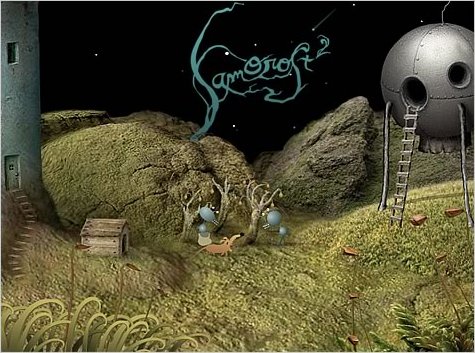
Not long ago, and guided by general consensus among friends and critics, I decided to acquire Machinarium, the then recent work by Amanita Design. To my surprise, when buying the game I was given their previous one, Samorost 2 (its first part is free), and both game's soundtracks. Shortly after I refused to keep playing Machinarium (another story) and mostly forgot about Amanita.
Fast forward to a boring evening, when I discovered Samorost 2's installer in my PC. "Let's try this," I told myself (metaphorically; I don't usually talk to myself), "a free game can't be worst than most you pay for."
Amanita Design is a studio specialized, judging by their main games, in Flash development and extremely detailed graphics. Gray, complex landscapes play an important part in their games, as do their beautiful musical scores. These two elements have earned the studio repetead and completely deserved awards.
Amanita's designs are, in essence, point and click graphic adventures with a very simple inventory system, if any, minimal stories, pretty backgrounds and limited interaction.
Amanita's designs are, in essence, point and click graphic adventures with a very simple inventory system, if any, minimal stories, pretty backgrounds and limited interaction.
In Samorost 2, the main character -let's call him/her Pyjama- wakes up to find a couple of space thieves stealing fruits from the garden's tree, and taking the guardian dog as a bonus. As a result, Pyjama embarks on an mission to rescue Dog and return to the home asteroid safe. And the player, not to be confused with the star, goes along for the ride.
Pyjama's adventure is a nice one, full of funny moments, detailed drawings, charming characters and some curious puzzles. So there are good things regarding this game. From time to time my efforts were rewarded with something more than "you managed to cross the door", which felt good, but not good enough. I always had this sour taste of frustration reminding me that I wasn't that much enjoyed.
But critics and players loved this game, so I am outnumbered. Am I wrong or do I have the right to call my Graphic Adventure Demise Culprit #3 to scene?
2011-02-14
On OnLive
By now, every person even slightly interestedn in video-games should know about OnLive. Those who don't, would do well to read a bit on it and its competitors. Those in Nort America might even try it out, if their internet connection allows it.
In brief: OnLive is a remote gaming system. A player can start a game from the service in a not too powerful machine, and play, ideally, as if the computer was a modern monster. The game itself is executed on OnLive's computer cluster, in one of their machines. The player receives a video stream of the screen, and the input is sent back to OnLive to process inside the game. If the internet connection holds up, the experience should remain a close match to playing on your own PC.
The limitations this system imposes are in resolution (the stream is limited to 1280x720), the artifacts caused by the video compression and the time passed since the player sees an image (or hears a sound) and the game receives the player's response.
Then, what is so important about OnLive? It is, obvlously, an industry changing concept. The PC and console markets have been led by power hungry machines, paid for by the players. Now, costs can be sustained by an external party, theoretically reducing the cost of playing the latest and biggest games.
It is also relevant as an innovative distribution method: there is just no distribution. A client pays for the right to play a game. No installation files, disc, activation any more. And no more patching on the player's side. And you can play anywhere, on any PC.
Unfortunately, the games are associated to a single account, so you can no longer share a game with your brother, friend, partner... without sharing the whole account. Unless multi-person accounts are offered, obviously.
For developers, on the other hand, OnLive could imply a console like environment for PC games. OnLives machines can be tested, avoiding the hell of multi-configuration set-ups. And, at the same time, can always aim for the best possible graphics, without taking into account the number of high-end computers in the market. Of course, these points are irrelevant as of now, given the low penetration of OnLive in comparison to world wide PC games sales.
But what are the potential effects of such an environment on the whole industry? In the coming years, as internet connections improve, hardware gets more robust and OnLive and similar companies finetune their core systems, things will start changing. It might not be OnLive, but it is undeniable that someone, some day, will triumph with a similar scheme*.
Trying to predict future market movements is considered by many a great exercise, even if you get everything wrong. So, what are my predictions for gaming, in the light of this technology?
Subscribe to:
Posts (Atom)