Showing posts with label comparisonchart. Show all posts

2011-05-07

Review: Mass Effect 2 (BioWare, 2010)


Platform: PC, X360, PS3

Mass Effect, the first game in BioWare's intergalactic saga, turned out to be one of the best RPG blenders of the past decade. Despite some flaws, it might even be one of the best in video game history. It is up there with System Shock and Deus Ex, becoming part of a trinity of very different games with very similar concerns, each of them a testimony of how far available technology could go to create believable environments, characters and plot, and how to take advantadge of constraints.

System Shock, Deus Ex and Mass Effect have something else in common: their sequels departed considerably from the original. In System Shock and Deus Ex it was, mostly, a matter of technology and standard shifts. System Shock was released when the FPS genre was still crystalizing and its, admittedly overcomplicated, control and inventory schemes failed to become the rule. Deus Ex 2, on the other hand, changed the reference platform from PC to the booming console market. In both cases, the result was a considerably simplified version of the first game. However, Looking Glass used the opportunity to create a completely new kind of game, while Deus Ex: Invisible War remained a dumbed down version of its predecessor.

System Shock 2 is nowadays a classic, while Invisible War is just not.

Between Mass Effect and Mass Effect 2 no such technology or standard shift happened. All the modifications to the formula were the result of fans feedback, internal development and, I guess, some pressure from EA. And those changes left a mark even bigger and scarier than anything done in Deus Ex: Invisible War.

What happened?

Sequels of the world be aware of the tale of Mass Effect. Quite a start for a saga, raised from illusion, care and depth, by many loved, despite its flaws, into change it was compelled by EA's suits and internet boards.
Not too good a shooter nor much of an RPG, that was its cross, but the way of the bender was never meant to be easyly walked. Still it sold in the millions and, once DRM was gone, I bought it and rejoiced.

Things looked bright for BioWare and its new step-father, dollars in the pocket and still two sequels short, there was much to win, while little could be lost. Yet, greed took its toll, Mass Effect 2 was rushed to market, changed for the sake of change, dumbed down to please the masses of FPS, TPS players who about Mass Effect complained.

"The Mako is plainly a bore, with little to do in outer worlds, the arsenal too ample, the stats a ton, too much to watch and learn, overheating weapons are plain odd, and why is not Tali in my bed?"
"Just let us run and gun, the next gun better than the rest, picking weapons' not that great. I play to have some fun. Oh, and could you add some mini-games?"

Someone compiled all these requests, wrote them in a chart and forced them into the game. They might not fit well, or needed more thought to blend, but the release date must be met. "Just work less on the PC port. Like anyone will care."

And Mass Effect 2, my friends, is what we have left. By the way, this is the farthest I could take all this prosaic verse.

2011-03-29

Review: Shadow Complex (Chair Entertainmente w/ Epic Games, 2009)

 
Platform: XBLA

Shadow Complex is the first serious and successful attempt at recreating the feeling of oldschool 2D exploration shooters inside a 3D canvas. It's plain to see they focused on recovering everything good from Metroidvanias, while removing the design flaws and problems arisen by hardware limitations. A new aiming system, leveling bonuses or an attempt at story-telling are some of the additions they made to the Metroid formula.

A bit of history

Since the introduction of the third dimension in videogames many attempts have been made to recreate the classics in the new environments. Most of the time, however, the results have been underwhelming. The fast action available in simple 2D worlds proved constantly too much for the more complex settings required for believable 3D scenarios, unless action was limited to only two axes (Robotron X, Einhander).
Until Zelda 64's lock on was introduced, few had managed to get things slightly right. And even after that, failure has been pretty common. Proof of this is the respected Castlevania series, which, after four 3D iterations, found commercial success only when Mercury Steam decided to break with the old game style completely.
The Metroid series did better, with the Prime saga achieving almost unanimous praise, thanks to its merge of FPS mechanics with a lock on system, plus subtle story-telling. It did, however, rely on completely different gameplay and narrative styles than its precursors.

There is, as can be seen, a common thread going on, which is not even considering a return to the 2D. That approach has been left for handheld consoles, with the Metroid and Castlevania series for Nintendo systems, or remakes of old classics and shoot'm ups, like Ghosts'n Goblins for the PSP.
Of course, there have been constant homages, with 3D games re-creating 2D gameplay in small sections. The one I remember most vividly is Nier, which achieved levels of meta-gaming off the charts. Castlevania: Lament of Innocence and Metroid: Other M also played with pseudo 2D, although not too succesfully.

Chair Entertainment played it safe, making Shadow Complex a 2D game inside a 3D world. Movement is limited to the x/y plane, while enemies are free to move all around. As a result, Jason, the main character, is allowed to shoot in any direction too. The game automatically chooses how deep you are aiming, and it seldom does wrong.

Metroidvania at heart

Shadow Complex is probably the highest profile metroidvania ever done: edge technology, a big studio devoted completely to it, an expensive marketing campaign and the push from Microsoft. The studio dedicated apparently several months redrawing levels in paper form, calculating possible advance routes, secrets placement and planning all kinds of distractions to get the player off the track.
Also, the Metroid games were studied to he deepest detail, until their inner workings were grokked by the team at large.

2011-03-28

Review: Mass Effect (BioWare, 2007), Part 2


In my previous post I got into the shooter genes in Mass Effect, explaining what it did well, what did not and what compromises were made to please a bigger market. This time, I'll review the RPG in it, plus the setting and story.

Looking through the RPG lenses

Role-playing games are built on three main aspects: story, character stats and world interaction. The tighter they all feel, the better the final experience should be. Or, in other words, no matter how good your game is implemented and thought out, if those three pillars do not support steadily the game as a whole, the RPG player will notice.

BioWare were greatly experienced in managing all three elements, and it really shows in Mass Effect. The story starts well and ends better, with enough stops along the way; the world is complex and astonishingly detailed; the main character can be differentiated beyond genre, clothing and faces; and there are plenty of NPCs, secrets and things to pick up.
Let's talk about each of them with a little more detail.

Universe and story in Mass Effect

There are a lot of things to learn in this new Universe humanity has recently (35 years ago) discovered. Lots of worlds, life forms, political bodies, rebels... Almost anything. Many of them are presented as the plot or secondary quests advance and other times it is just in the form of codex entries. It is true that, pretty often, Shepard's ignorance of the most basic information of important issues is startling, making the exposition a little too evident.
But, most of the time, the player is simply provided some new info, readable on the menu, which add a lot of flesh to the limited bits of info the story forces on you. And, believe me, there is a lot of info in those codex. Every extraterrestrial race, coalition, political group or history event is explained in there. Quite a lot of the many hours I spent on my first play-through were spent reading every little bit.
And if that is detailed, wait for the moment you reach another planets. Each planet, no matter how irrelevant or small, has a description of formation, nature or civilization. And, what's even better, many of them are homages to sci-fi classics. Trantor and Dune are among the most recognizable, but there is space for many other plays on the genre. Quite a delightful time waster.

And the story does not lag around. I'll avoid the details, but the events progress smoothly, even when the player is allowed to play the middle section in whichever order she decides. There is a lot of conversation involved, but most are so well integrated with the events at hand that they come naturally.
The beginning is epic, and leaves many doubts about what is really happening, and as it all plays out, you start filling holes, discovering new, bigger ones and spending all the time intrigued about the possibilities. And when the final revelations come, they do with a vengeance. Lots of loose threads are tied, and even stuff you thought was only there for the looks is revealed to play major roles.
The last great conversation, right before the final assault, is delivered in such a high note that I was simply unable to pay attention to all the action coming after it for a while. It is one of the best moments I've experienced in a sci-fi work.

2011-03-15

Review: Mass Effect (Bioware, 2007), Part 1

Platform: PC, Xbox 360


It's hard to talk about Mass Effect without getting myself into a full-blown article on BioWare. A long loved company focused in a long lived genre, maintaining it while it slowly loses ground to the new guys in the party. In my mind I used to paint them as fairy tales knights, with shiny armour, declaring eternal love and care for the target of their affections.
And still, I cannot be considered a great fan on this company. Simply put, I haven't played that many of their games. I loved Baldur's Gate, but never played its expansion nor its sequel. Years later I tried Neverwinter Nights but found it too dissapointing, so I left it after 2 hours or so. Knights of the Old Republic and Jade Empire went by and I haven't played them yet, although I really want to.
And then, Mass Effect and Dragon Age came, which would be the last independently developed games before EA acquired the studio.
Yet, until very recently, I still respected the BioWare logo. It is possible that the cause was mainly my associating them with Planescape: Torment (Black Isle Studios), plus many friends of mine love their games and are constantly relating how they abused Baldur's Gate 2's magic and critical systems to destroy dragons in less than a D&D combat turn.
It's funny: most good memories I have of BioWare are actually not mine.

Mass Effect is, in few words, the evolution of BioWare from the complexities of its original Baldur's Gate and the D&D ruleset into a simpler experience, intertwined with shooter elements. It is, as well, a branching point in character complexity and plot scripting, providing a lot more depth, at the cost of some diversity.

There is so much I want to say of Mass Effect, and so little time to put it into words, that I'll post two separate articles. The first one, this, will focus on the shooter aspects, while the second one will look into the RPG segments and story.

Mass Effect

So, Mass Effect. A shooter developed by a renouned RPG developer constantly trying to make its games more immediate and accessible. Neverwinter Nights felt like a complex Diablo, while Jade Empire was a beat'm up with lots of abilities, few stats and no classes, but still many points to assign. Knights of the Old Republic, however, remained more faithful to their origins, for what I know, in spite of being an action game.
Mass Effect plays a similar trick, becoming a shooter while keeping a lot of its RPG origins: multiple missions, lots of dialog and weapons and a big stats/abilities system. It even goes further than BioWare's previous efforts in world and character design, producing a unique, rich universe with personality. It also gives the player more options than usual in how to play the main story or interact with partners.

If it has so many stats, it has to be an RPG

2011-03-05

Review: Beyond Good & Evil (Ubisoft, 2003)

Platform: PC, GameCube, PS2, Xbox, X360 (XBLA), PS3 (PSN, pending release)
Website: Wikipedia


With the re-release of Beyond Good & Evil on current gen consoles (Xbox 360 and PS3), reviewes of this modern classic have appeared everywhere. Apparently the new version features increased resolution (1080p), improved textures, the dreaded achievements/trophies and, most notably, a revamped soundtrack with some new tracks and better audio quality. The original music was great, but word is the updated version kicks even more ass.
Otherwise, the game remains the same. Same mechanics, art direction, level design and sense of humour. And that's good, because I don't care much about graphics and can review the original while saving the money.

There is no point in repeating what every other site out there has already posted, so I'll focus on what sites have not mentioned so much and, in a form of meta-review, about the reviewes themselves.

About reviewes

Before jumping into the game, I'll make a reference to the reviewes I've read lately about this game. All praise Beyond Good & Evil, of course, being one of the points usually featured its originality: in an industry dominated by copy-cats and sequels, it was an inspiring change, innovating old formulas and exploring new areas, unconstrained by the weight of an intellectual property (partly).
Everyone agrees that re-releasing this game was a no brainier. A great experience, beloved by all the critic, which sold poorly, but can easily pay for itself now. Also, any chance it gets to gather attention is welcome.

However, the very same people that admire its uniqueness always end asking everyone to buy the remake, so a sequel is finally released. What? What about that anti-sequels, pro-originality speech? Forgotten in two paragraphs?
Well, I don't want a sequel to Jade's adventures and I didn't like the cliffhanger ending. I'd love to see Ancel direct new games, not rehashes of old ones, because he's shown he can do great things. Rayman was really good, but by the second installment I was already sick of it. I don't want Jade to suffer at the hands of her very own Raving Rabbids.

2011-02-18

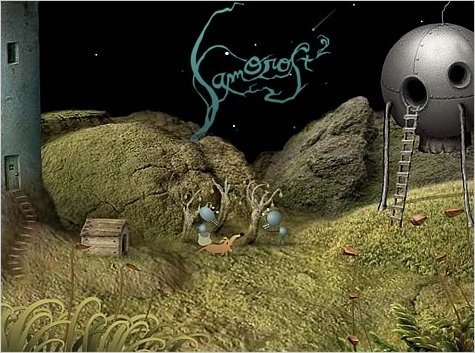
Review: Samorost 2 (Amanita Design, 2005)

Platform: Linux, Windows, Mac (digital distribution), Flash (web browser) 

Not long ago, and guided by general consensus among friends and critics, I decided to acquire Machinarium, the then recent work by Amanita Design. To my surprise, when buying the game I was given their previous one, Samorost 2 (its first part is free), and both game's soundtracks. Shortly after I refused to keep playing Machinarium (another story) and mostly forgot about Amanita.
Fast forward to a boring evening, when I discovered Samorost 2's installer in my PC. "Let's try this," I told myself (metaphorically; I don't usually talk to myself), "a free game can't be worst than most you pay for."

Amanita Design is a studio specialized, judging by their main games, in Flash development and extremely detailed graphics. Gray, complex landscapes play an important part in their games, as do their beautiful musical scores. These two elements have earned the studio repetead and completely deserved awards.
Amanita's designs are, in essence, point and click graphic adventures with a very simple inventory system, if any, minimal stories, pretty backgrounds and limited interaction.
In Samorost 2, the main character -let's call him/her Pyjama- wakes up to find a couple of space thieves stealing fruits from the garden's tree, and taking the guardian dog as a bonus. As a result, Pyjama embarks on an mission to rescue Dog and return to the home asteroid safe. And the player, not to be confused with the star, goes along for the ride.
Pyjama's adventure is a nice one, full of funny moments, detailed drawings, charming characters and some curious puzzles. So there are good things regarding this game. From time to time my efforts were rewarded with something more than "you managed to cross the door", which felt good, but not good enough. I always had this sour taste of frustration reminding me that I wasn't that much enjoyed.
But critics and players loved this game, so I am outnumbered. Am I wrong or do I have the right to call my Graphic Adventure Demise Culprit #3 to scene?

2011-02-08

Review: The Legend of Zelda series

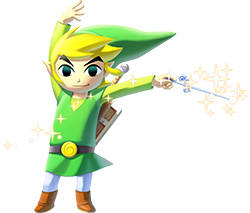
Link: one of the longest lasting and most beloved icons in the interactive media world. An almost eternal boy, constantly saving the world at the last moment from Ganondorf's evil schemes, in which Princess Zelda is always involved, to a varying extent. Most often, she is the recipient of some form of legendary power and the key to controlling the TriState Area Triforce.
We've heard this story six times already (counting only Nintendo home console versions), with different variations. However, in terms of gameplay, evolution was limited to the first four games. Zelda II was a significant departure from the original, Super Zelda improved Zelda's top-down exploration almost to perfection, and Zelda 64 changed the way 3D adventure games were built. However, from Zelda 64 on, little has changed. Each game in the series would get its defining characteristic/mechanic, but general story, controls, menus or items remained pretty much the same.

Late Beginnings

I love A Link to the Past as much as anyone, even though I never finished it. It had good puzzles, tricky dungeons and awesome dungeon bosses. What made boss fights so good was the fact that they were difficult, until you learnt the method. After attacking the enemy three or four times, each with a little higher difficulty, the game acknowledged you as the winner. No five minutes battles, no constant die and retry, no rinse and repeat. This, for me, is the defining mark in the Zelda genre, and its greatest gift to computer game design. It is recognizable in every Zelda game afterwards, but also in the Metroid saga, Soul Reaver or Beyond Good & Evil.
The Light World
In other aspects, the game always felt quick, even when you were stuck. The moment you entered a room you easily identified every relevant item in seconds. Killed some minions, activated a switch and moved to the next area. Opened a chest, saw a 2 seconds description and moved on. Killed a boss, collected a heart and an object, got out of the dungeon in seconds and moved on. Every action was snappy and the game was constantly pushing you forward, with short conversations and a very streamlined interface.
Basically, Super Zelda kept the obstacles between the player and the actual Hyrulean struggle to a minimum.

2011-01-04

Review: The Path (Tale of Tales, 2009)

Platform: PC (digital distribution)
Website: http://tale-of-tales.com/ThePath

I have a problem with this game, being that I don't know if it is one at all. Much like with Noby Noby Boy, most times I start talking or writing about it, I end questioning the nature of games, their purpose and means. Where does the game end and the art begin? Is it even a game? It is only fitting that The Path is the first review I upload, as the questions it raises regarding the whole industry are the reason why this blog is called GameNotGame.

What is The Path?

The Path is not funny, but intriguing, not pretty, while attractive, nor familiar, yet easy to relate to. It has a message, but not a speech, a challenge, but no difficulty.
The Path, as a product, is defined by how few of the definitions of videogame it matches, yet it could still be one. It is labelled an "art game", and done with, or a non game, by its very creators, and thrown in a completely different basket. In my opinion, it is simply the wording that is wrong. Twilight and A Widow for one Year are both novels, but their artistic merits are separated by eons.
Sincerely, I don't care that much if it is a game or not. I loved the time I spent with the girls and their lifes, trying to figure out what the designers were telling me through them, reflecting on what I could learn from their fragmented tales.

The Path, as a game, is defined by its shortcomings. The controls are not the best possible, the mechanics fuzzy at times, the objective misguiding. However, Tale of Tales has built the game on these issues, making them a part of the experience, part of the metaphore. Life as a teenager is not clear, the faster you run through it, the less you know where you'll end, the slower, the less you'll achieve.
Meet our red riding hoods: Ginger, Rose, Scarlet, Ruby, Robin and Carmen.
The Path is to games what growing up is to becoming 18. Reflection is so integral to the process that there is not a stop once you beat it, but keeps going on until you stop learning from it. And what you learn is not that you may now drink alcohol, or drive, but that those activities require a level of responsibility and many possible consequences, even some of the less desirable being worth the risk.

Game comparison chart

As I explained in a previous post, once I start uploading reviewes, I'll refrain from scoring them. Instead, I'll publish a chart with similar games, showing their quality difference with the reviwee.
The last two nights I've been awake for much longer that it is healthy, programming the tool to automatically generate the game charts, based on simple better/worse pairs. Once the ideas were established, it was only a matter of coding, learning how SVG works, remembering how to generate XMLs with Linq's XDocument -never again without it-, and using some advanced XML features.
So, I'll explain in a few words what I have done.

First of all, is the data I work with. I keep a simple XML document with games and comparisons. Games are specified as:
    <games>
        <game id="Dragon Age" year="2009" url="http://social.bioware.com">
            <names>
                <name value="Dragon Age: Origins"/>
            </names>
        </game>
        <game id="Mass Effect 2" year="2010"/>
        <game id="Mass Effect" year="2008"/>
        <game id="Baldur's Gate" year="1996" url="http://www.gog.com"/>
        <game id="Baldur's Gate 2" year="1997">
            <names>
                <name value="Baldur's Gate II"/>
                <name value="Baldur's Gate II: Shadows of Amn"/>
            </names>
        </game>
        <game id="Neverwinter Nights" year="2000"/>
        <game id="Icewind Dale" year="1997"/>
        <game id="KotOR" year="1999">
            <names>
                <name value="Knights of the Old Republic"/>
            </names>
        </game>
        <game id="Oblivion" year="2006">
            <names>
                <name value="The Elder Scrolls IV: Oblivion"/>
            </names>
        </game>
        <game id="Gothic" year="2001"/>
        <game id="Fallout" year="1997"/>
        <game id="Planescape: Torment" year="2000"/>
    </games>
The ID is the name the game is usually known for, the URL would point to that game's review, if I have one up, and the year... I have not verified them for this test file, so they are most probably not the year the game was released.