2011-02-18

Review: Samorost 2 (Amanita Design, 2005)

Platform: Linux, Windows, Mac (digital distribution), Flash (web browser) 
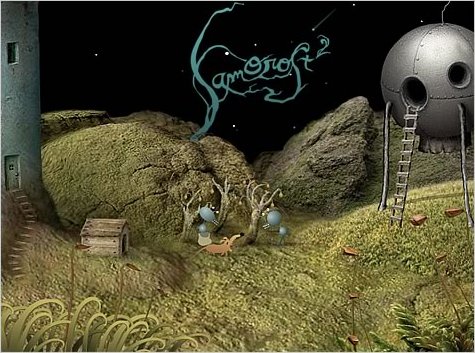
Not long ago, and guided by general consensus among friends and critics, I decided to acquire Machinarium, the then recent work by Amanita Design. To my surprise, when buying the game I was given their previous one, Samorost 2 (its first part is free), and both game's soundtracks. Shortly after I refused to keep playing Machinarium (another story) and mostly forgot about Amanita.
Fast forward to a boring evening, when I discovered Samorost 2's installer in my PC. "Let's try this," I told myself (metaphorically; I don't usually talk to myself), "a free game can't be worst than most you pay for."

Amanita Design is a studio specialized, judging by their main games, in Flash development and extremely detailed graphics. Gray, complex landscapes play an important part in their games, as do their beautiful musical scores. These two elements have earned the studio repetead and completely deserved awards.
Amanita's designs are, in essence, point and click graphic adventures with a very simple inventory system, if any, minimal stories, pretty backgrounds and limited interaction.
In Samorost 2, the main character -let's call him/her Pyjama- wakes up to find a couple of space thieves stealing fruits from the garden's tree, and taking the guardian dog as a bonus. As a result, Pyjama embarks on an mission to rescue Dog and return to the home asteroid safe. And the player, not to be confused with the star, goes along for the ride.
Pyjama's adventure is a nice one, full of funny moments, detailed drawings, charming characters and some curious puzzles. So there are good things regarding this game. From time to time my efforts were rewarded with something more than "you managed to cross the door", which felt good, but not good enough. I always had this sour taste of frustration reminding me that I wasn't that much enjoyed.
But critics and players loved this game, so I am outnumbered. Am I wrong or do I have the right to call my Graphic Adventure Demise Culprit #3 to scene?

2011-02-14

On OnLive

By now, every person even slightly interestedn in video-games should know about OnLive. Those who don't, would do well to read a bit on it and its competitors. Those in Nort America might even try it out, if their internet connection allows it.

In brief: OnLive is a remote gaming system. A player can start a game from the service in a not too powerful machine, and play, ideally, as if the computer was a modern monster. The game itself is executed on OnLive's computer cluster, in one of their machines. The player receives a video stream of the screen, and the input is sent back to OnLive to process inside the game. If the internet connection holds up, the experience should remain a close match to playing on your own PC.
The limitations this system imposes are in resolution (the stream is limited to 1280x720), the artifacts caused by the video compression and the time passed since the player sees an image (or hears a sound) and the game receives the player's response.

Then, what is so important about OnLive? It is, obvlously, an industry changing concept. The PC and console markets have been led by power hungry machines, paid for by the players. Now, costs can be sustained by an external party, theoretically reducing the cost of playing the latest and biggest games.
It is also relevant as an innovative distribution method: there is just no distribution. A client pays for the right to play a game. No installation files, disc, activation any more. And no more patching on the player's side. And you can play anywhere, on any PC.
Unfortunately, the games are associated to a single account, so you can no longer share a game with your brother, friend, partner... without sharing the whole account. Unless multi-person accounts are offered, obviously.

For developers, on the other hand, OnLive could imply a console like environment for PC games. OnLives machines can be tested, avoiding the hell of multi-configuration set-ups. And, at the same time, can always aim for the best possible graphics, without taking into account the number of high-end computers in the market. Of course, these points are irrelevant as of now, given the low penetration of OnLive in comparison to world wide PC games sales.

But what are the potential effects of such an environment on the whole industry? In the coming years, as internet connections improve, hardware gets more robust and OnLive and similar companies finetune their core systems, things will start changing. It might not be OnLive, but it is undeniable that someone, some day, will  triumph with a similar scheme*.

Trying to predict future market movements is considered by many a great exercise, even if you get everything wrong. So, what are my predictions for gaming, in the light of this technology?

2011-02-08

Review: The Legend of Zelda series

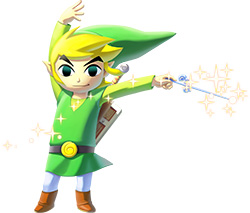
Link: one of the longest lasting and most beloved icons in the interactive media world. An almost eternal boy, constantly saving the world at the last moment from Ganondorf's evil schemes, in which Princess Zelda is always involved, to a varying extent. Most often, she is the recipient of some form of legendary power and the key to controlling the TriState Area Triforce.
We've heard this story six times already (counting only Nintendo home console versions), with different variations. However, in terms of gameplay, evolution was limited to the first four games. Zelda II was a significant departure from the original, Super Zelda improved Zelda's top-down exploration almost to perfection, and Zelda 64 changed the way 3D adventure games were built. However, from Zelda 64 on, little has changed. Each game in the series would get its defining characteristic/mechanic, but general story, controls, menus or items remained pretty much the same.

Late Beginnings

I love A Link to the Past as much as anyone, even though I never finished it. It had good puzzles, tricky dungeons and awesome dungeon bosses. What made boss fights so good was the fact that they were difficult, until you learnt the method. After attacking the enemy three or four times, each with a little higher difficulty, the game acknowledged you as the winner. No five minutes battles, no constant die and retry, no rinse and repeat. This, for me, is the defining mark in the Zelda genre, and its greatest gift to computer game design. It is recognizable in every Zelda game afterwards, but also in the Metroid saga, Soul Reaver or Beyond Good & Evil.
The Light World
In other aspects, the game always felt quick, even when you were stuck. The moment you entered a room you easily identified every relevant item in seconds. Killed some minions, activated a switch and moved to the next area. Opened a chest, saw a 2 seconds description and moved on. Killed a boss, collected a heart and an object, got out of the dungeon in seconds and moved on. Every action was snappy and the game was constantly pushing you forward, with short conversations and a very streamlined interface.
Basically, Super Zelda kept the obstacles between the player and the actual Hyrulean struggle to a minimum.

2011-01-31

Global Game Jamming!

This weekend (28-30 January) I've participated in the Global Game Jam, the largest 48 hours game dev jam so far. It's been awesome, frustrating, funny, tiresome, stressing and a bit unhealthy. But I survived the ordeal and came out with a finished game, which I still find amazing.

Technology and engines have advanced so much and become so cheap (free as in "free beer"?) in the later years that it is possible to do quite a lot in very little time. This has increased the number of people willing to take part in such events, as well as the average know-how. The most beloved dev platforms seem to be Unity 3D and XNA. I was expecting some Unreal Engine projects, but none surfaced at my location. There were also no iPhone, Windows Phone 7 or Android, so Flash, Java and self-developed engines filled the minority ranks.

The game I worked in is No Ground Left, developed by a small team of two programmers and an artist. Since it was created in Unity, we have Windows and MacOS binaries (tested in Windows 7 and MacOS X). The complete package, including sources, is available from the previous link.
We also have a browser version of the game hosted on GGJ's servers. It has not been extensively tested and content streaming seems to cause some troubles, so you might prefer to try the full application. Also, Unity's Web Player is not as stable as I'd desire.
However, the web version, which was uploaded some hours later, includes an important bugfix and some menu improvements, so it is closer to a good version of the game.

Everything developed during the Global Game Jam 2011 is released under the Creative Commons Attribution-NonCommercial-ShareAlike license, so everyone is free to pick our game sources, change them significatively and distribute the results (for non-commercial purposes), as long as we are credited as the original authors.
I took advantadge of this license to include some professional music in the game. Especifically, I used three slightly and quickly modified cuts of Nine Inch Nail's The four of us are dying for the ambient music. Trent Reznor released that track's album, The Slip, with the exact same license GGJ required us to use, so everything fit perfectly.

2011-01-28

Game Design Challenge: Time for Change (part 2)

And this was my second proposal for the gender altering challenge. It was just an idea I found funny, so don't take it too seriously.
I would have loved to send another one, this time changing Gabriel Knight's assistant Grace Nakimura into a sophisticated adult man. He would have served as a balance for Gabriel's untidiness, and I was considering whether to present him as a sexual rival or partner. Or both. But alas! I didn't have the time to think it properly and compose the text. A shame.

But here you have Canabalte!
Canabalte

The moment you heard of the robot invasion in the Capital, you knew your little Canabalt would leave his apartment with the first clothes he found and without brushing his teeth. That's not the way men should run around, even when the world as we know it is collapsing. So, you have taken your car and driven as fast as possible from the suburbs to the outer limits of the Capital. From here on, you'll have to run and jump to reach Canabalr's apartment before he leaves.

2011-01-17

Game Design Challenge: Time for Change (part 1)

I loved the concept of changing a game by shifting the main character gender, so for this particular challenge I sent a couple of ideas; one serious, the other not so much.
The first of them, Princess of Persia made it to the second place, in a draw with another Prince of Persia re-imagining. Although I don't like Shin's display of the female character, I have to admit that his/her game is quite a funny take on Ubisoft's 2008 reboot of the franchise.

Some time after the results were published, I found a forum of female gamers/game designers in which they discussed the finalists*. I would have loved to get something from there, mainly because they criticized my Princess. Unfortunately, I got the impression that most of the critics barely read the first two paragraphs.
However, their point that women are not that much interested in the archetype hero journey made me wonder. In the end, and judging from best-selling books, movies and classics, I think women do connect with the archetype about as much as men, but from a different perspective. But this is another story which shall be told in another moment.

* Being the pile of shit google search is starting to be, I am unable to find it again. If someone stumbles upon it, notify me in the comments and I'll gladly update the post.
Princess of Persia

After 30 minutes, only two choices remain: marry the Vizier to save your lover's life or after his execution. Your last hope for rescue dead, you call the Vizier to submit, but suddenly realize it is up to you to save yourself. The Vizier grinning in front of you, you slowly manipulate your braid, look him in the eyes and smile when your small dagger rips the vermin's chest. After seething it back in your braid, you leave your royal chambers, with one half of the sand silently waiting to reach the bottom of the clock.

"Marry me... or he will die within the hour."

2011-01-12

Graphic adventures demise rant

Before I start posting reviewes of graphic adventures, I find myself forced to write a state of the art, plus my opinion on the genre's slow death. Please, indulge me.

As you should know, in the 80s and early 90s, adventure games reigned supreme in the world of videogames. Their narrative had no equal, as did their ability to treat serious subjects and make people ponder about them. But, as the century approached its end, the genre lost its following and energy.
It is a recognized sport among adventure fans to look for culprits of this decline, and everyone has their favourite. I like to blame:
  1. The lack of evolution in the genre.
  2. The inability to properly embrace the new technologies and platforms (partially related to #1).
  3. The resignation of players and critics, who in the end welcomed almost any new graphic adventure, without regards to actual quality, sinking the standard for the genre and scaring new players away.
Graphic adventures were built from three basic tasks: pick object (or person), use object (or person) and talk to person (or object), all of them poorly executed for decades. Pixel hunting, objects indistinguisible from the scenary, endless conversations of no interest to game progression, cumbersome inventory systems and outdated movement mechanisms were the rule.
From time to time, a developer would discover a way to improve one of these (Alone in the Dark hybridation, Myst's lack of inventory, Gabriel Knight 3's navigation), and implement it in a succesful game. But other designers would rarely include other's ideas into their new game. Copying was not well regarded and, if it were, modifying the engine a studio had used for several titles was not that easy and/or economically viable.

But this blaming is of little relevance in the real world. What is important is not answering "why did graphic adventures dissappear", but "why did most gamers not care at all". You see, people still bought games, even bad ones, by the millions, but adventures only got a waning portion of that cake, no matter how good or praised they were. How can you explain that?
What had made graphic adventures shine over other genres was a mix of their depth in story, characters and humour. Another feature was their relative simplicity, when compared to space shooters, platformers, etc. Anyone with minimum computer expertise could pick up a graphic adventure and click around the screen, select verbs, objects, people and laugh for a while. Puzzles also were part of the magic formula: solving them felt great, and telling your friends when they were stuck was even better.

2011-01-09

Game Design Challenge: iPad

Coinciding with the launch of Apple's gadget, and much like with the 3DS right now (January 2011), GameCareerGuide requested ideas for iPad games.
Some time ago I had quite a laugh watching youtube videos of finger skaters in toilets, desks or cardboard parks. Given that my favourite winter sports are curling and figure skating, I decided to adapt that finger experience to the iPad.
I didn't make it into the honorable mentions with Fingur Skating, which really made me wish there was some kind of feedback to the proposals. Is it the name? I knew I should have gone for Fingure Skating! Or the idea could be clearer? I know some of the mechanics are not that fleshed out, but that's not a problem usually. Mmmh.

Fingur Skating

Youtube's major impact in society has been the revelation that supposedly niche hobbies were not at all. People started timidly uploading their videos, just to find they were not the first to [weird things here]. One of the most endearing trends I found were the finger skaters, with their absurd tricks. I don't enjoy skate boarding that much, but I love figure skating and abdsurd games. Fingur Skating is the perfect blend of both.

The idea is simple: move your fingers on the iPad screen simulating the movement, spins and, to a certain point, jumps of a professional figure skater. Thanks to the size of the screen, you have the freedom to move graciously around and even play with a partner, with little scrolling. The ice rink would fit in 4 screens. The action will be followed from a cenital camera, with the player synchronizing the fingers to the skater's limbs, usually the feet, with both fingers while skating and only one when doing spins, following the curves traced by the feet or arms.
In the normal playing mode, the skater will perform a preconfigured series of figures and acrobatics, with the player going along. There will be visual cues signalling future movements, unfolding as subtle lines, in the manner of minimalist vines, and fading behind the skater, leaving small trails on the ice. Failure to properly execute the movements will result in drops and desynchronizations, which would show in the final punctuation.

2011-01-04

Review: The Path (Tale of Tales, 2009)

Platform: PC (digital distribution)
Website: http://tale-of-tales.com/ThePath

I have a problem with this game, being that I don't know if it is one at all. Much like with Noby Noby Boy, most times I start talking or writing about it, I end questioning the nature of games, their purpose and means. Where does the game end and the art begin? Is it even a game? It is only fitting that The Path is the first review I upload, as the questions it raises regarding the whole industry are the reason why this blog is called GameNotGame.

What is The Path?

The Path is not funny, but intriguing, not pretty, while attractive, nor familiar, yet easy to relate to. It has a message, but not a speech, a challenge, but no difficulty.
The Path, as a product, is defined by how few of the definitions of videogame it matches, yet it could still be one. It is labelled an "art game", and done with, or a non game, by its very creators, and thrown in a completely different basket. In my opinion, it is simply the wording that is wrong. Twilight and A Widow for one Year are both novels, but their artistic merits are separated by eons.
Sincerely, I don't care that much if it is a game or not. I loved the time I spent with the girls and their lifes, trying to figure out what the designers were telling me through them, reflecting on what I could learn from their fragmented tales.

The Path, as a game, is defined by its shortcomings. The controls are not the best possible, the mechanics fuzzy at times, the objective misguiding. However, Tale of Tales has built the game on these issues, making them a part of the experience, part of the metaphore. Life as a teenager is not clear, the faster you run through it, the less you know where you'll end, the slower, the less you'll achieve.
Meet our red riding hoods: Ginger, Rose, Scarlet, Ruby, Robin and Carmen.
The Path is to games what growing up is to becoming 18. Reflection is so integral to the process that there is not a stop once you beat it, but keeps going on until you stop learning from it. And what you learn is not that you may now drink alcohol, or drive, but that those activities require a level of responsibility and many possible consequences, even some of the less desirable being worth the risk.

Game comparison chart

As I explained in a previous post, once I start uploading reviewes, I'll refrain from scoring them. Instead, I'll publish a chart with similar games, showing their quality difference with the reviwee.
The last two nights I've been awake for much longer that it is healthy, programming the tool to automatically generate the game charts, based on simple better/worse pairs. Once the ideas were established, it was only a matter of coding, learning how SVG works, remembering how to generate XMLs with Linq's XDocument -never again without it-, and using some advanced XML features.
So, I'll explain in a few words what I have done.

First of all, is the data I work with. I keep a simple XML document with games and comparisons. Games are specified as:
    <games>
        <game id="Dragon Age" year="2009" url="http://social.bioware.com">
            <names>
                <name value="Dragon Age: Origins"/>
            </names>
        </game>
        <game id="Mass Effect 2" year="2010"/>
        <game id="Mass Effect" year="2008"/>
        <game id="Baldur's Gate" year="1996" url="http://www.gog.com"/>
        <game id="Baldur's Gate 2" year="1997">
            <names>
                <name value="Baldur's Gate II"/>
                <name value="Baldur's Gate II: Shadows of Amn"/>
            </names>
        </game>
        <game id="Neverwinter Nights" year="2000"/>
        <game id="Icewind Dale" year="1997"/>
        <game id="KotOR" year="1999">
            <names>
                <name value="Knights of the Old Republic"/>
            </names>
        </game>
        <game id="Oblivion" year="2006">
            <names>
                <name value="The Elder Scrolls IV: Oblivion"/>
            </names>
        </game>
        <game id="Gothic" year="2001"/>
        <game id="Fallout" year="1997"/>
        <game id="Planescape: Torment" year="2000"/>
    </games>
The ID is the name the game is usually known for, the URL would point to that game's review, if I have one up, and the year... I have not verified them for this test file, so they are most probably not the year the game was released.